A Winter Walk for Reading a Hillside
A winter walk for reading a hillside helps you notice slope, drainage lines and landform, with a simple choice of route and a grounded way to observe.
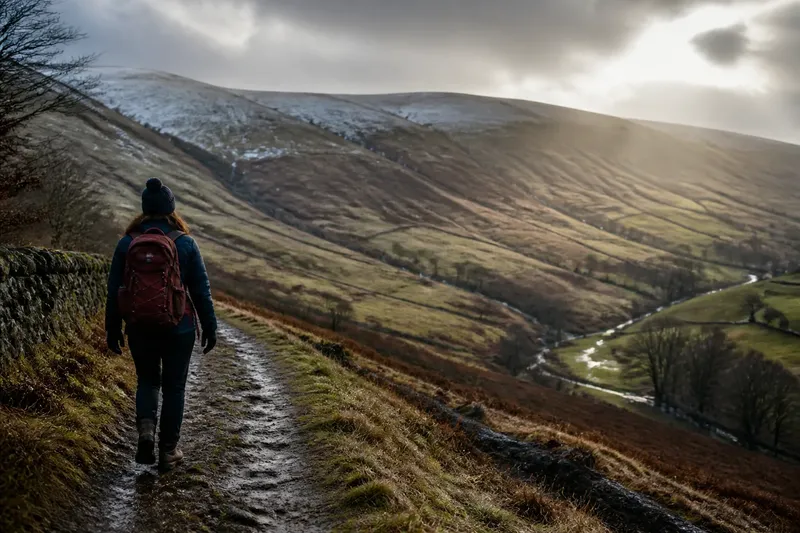
On a cold walk, a patch of dark ground can catch your eye before the view does: water has gathered there, or the soil is holding more damp than the slope around it. A winter walk for reading a hillside is less about identifying every feature than giving your eyes time to connect the ground beneath your boots with the shape in front of you.
Winter often makes those connections easier to see. Leaves have fallen from hedges and trees, grasses are pressed down, and wet ground picks out small channels. But a hillside is not a diagram, and one visible mark rarely tells you how it formed. Treat the walk as a way to observe slope, drainage and surface form, not as evidence for a confident story about the land’s past.
Which kind of winter walk suits your attention?
There are three useful ways to approach a hillside: follow a contouring path, climb or descend across the slope where a public route allows it, or stay low and read the hillside from its foot. Each gives a different view. Choose the one that fits the ground, your comfort and the question you want to carry.
Follow the slope across the hillside
A path that runs roughly along a slope lets you compare neighbouring patches without constantly changing height. Look sideways as you walk: does the hillside rise steadily above you, or does it bulge into a shoulder and then tuck into a hollow? This is a good option if you want to read the outline of the land and notice how small changes in shape affect where water travels.
Contour paths can make subtle forms legible because your viewpoint changes gradually. A shallow dip may become clear only when you see how it interrupts the line of the slope. Keep your eyes moving between near and far ground; a feature that looks like a hollow at close range may be part of a broader valley shape.
Cross the slope when an established route permits it
A route that goes uphill or downhill brings changes in steepness into focus. You can feel a sustained incline underfoot, then notice where the ground briefly eases or folds. This suits walkers who are comfortable with a more physical route and want to compare the upper slope, middle slope and foot as distinct positions.
Do not cut across private land, fragile vegetation or wet ground just to get a better angle. Use a marked public path or an established track, and let the route set the limits of your view. A safe, incomplete observation is more useful than a close look that damages the ground or puts you at risk.
Read the hillside from its foot
From a level track or open viewpoint below, the whole slope may be visible at once. This is often the gentlest approach and can suit a family walk, a short outing or a day when the hillside is slick. Look for the overall profile first: a rounded shoulder, a long even incline, a hollow that interrupts the face, or a steeper section above a gentler apron.
The trade-off is that distant features can merge. A pale stripe might be a path, exposed soil or a change in vegetation; from below, its shape alone may not settle the question. You can still record its position and direction without deciding what made it.
What can the slope tell you underfoot?
Begin with the broad form. Is the incline steady, or does it steepen and flatten in bands? Does a ridge-like shoulder project from the hillside, or does the land curve inward to make a shallow re-entrant? These are plain descriptions of shape. They help you orient yourself without attaching an unverified cause to what you see.
Then compare the ground at different points. A path may feel firm on a convex shoulder and softer in a hollow, but the contrast can also come from shade, vegetation or recent weather. Notice the surface before interpreting it: compacted gravel, leaf litter, exposed roots, bare soil, short grass or standing water each offers a different texture to the eye and to your footing.
Small landforms are easiest to miss when you focus only on the distant skyline. A low bank may be visible as a change in light; a hollow may appear as a darker curve; a subtle rise may interrupt the line of a fence or path. These marks are worth noticing, but not every bank is natural and not every hollow is a drainage feature. Record what you can see before naming it.
Where does winter water leave a visible line?
After rain or thaw, water often makes its route visible for a while. Look for damp bands, little rills in bare soil, flattened grass pointing downhill, or a line of darker leaves collected at a dip. A broad, shallow swale can be more apparent than a sharply cut channel. In a wooded section, wet leaves and moss may trace a hollow even when no water is moving.
Stand where you can see the ground safely and follow the line with your eyes, not your boots. Does it run straight down the slope, bend around a shoulder, or join another faint line? A route can vanish beneath turf or leaves, so note where it is visible and where it becomes uncertain. A hillside may also carry several small flow paths rather than one obvious channel.
Do not read a damp patch as proof of a permanent stream, spring or old watercourse. It may reflect recent rain, a blocked drain, soil differences or shade. The useful observation is modest: water or moisture appears to collect here, and the ground’s shape seems to guide it in this direction.
How should you compare the three approaches?
Imagine you reach a hillside with a public contouring footpath, a steeper marked trail crossing it and a level lane below. The upper path is muddy, while the lane is firm. If your main interest is how the slope folds into hollows, the contouring footpath may offer the best sequence of views, provided it is safe to use. If you want to feel where the incline changes and the marked trail is in good condition, the cross-slope route may suit you. If the ground is too slippery or you are walking with someone who prefers level footing, the lane still lets you compare the whole profile and spot darker drainage lines from a distance.
The choice is not about getting the most complete account. It is about matching your question to the viewpoint you can use comfortably. Pick a contour route to compare neighbouring forms, a cross-slope route to notice changes in gradient, or a lower viewpoint to read the broad silhouette. If conditions are poor, shorten the walk or stay on firmer, established paths.
What should you ask yourself as you look?
How can I tell a hollow from a drainage line?
A hollow is a shape in the hillside; a drainage line is a route that water may take through it. Look for a converging dip in the ground, then separately note any dampness, rills or collected leaves that suggest recent flow.
Does bare ground reveal the hillside’s history?
Not by itself. Bare soil can result from foot traffic, weather, grazing, maintenance or natural exposure, and the visible patch may not reveal which applies.
What is useful to write down during the walk?
Use simple, checkable descriptions: “dark strip in a shallow dip”, “path bends around a shoulder” or “water marks stop beneath the grass”. A quick sketch of the slope’s outline can help you remember where each feature sat.
When is a view too uncertain to interpret?
If leaves, distance, mist or low light hide the edges of a feature, leave its name open. “Possible hollow” or “damp line, direction unclear” is a sound field note, not a failure to read the land.
What is not worth the effort?
There is little value in trying to label every small mark or infer a hillside’s history from one winter walk. You do not need a specialist app, a compass reading for every bend or a photograph of every patch of ground. A few clear observations, tied to a position on the slope, will usually serve you better than a notebook crowded with guesses.
If you take photographs, include enough of the surroundings to show where the feature sits. A close-up of dark soil may look striking but lose the slope that gives it meaning. A wider frame with a path, tree line or skyline can help you distinguish the feature from the hillside around it.
A winter walk for reading a hillside works best when you let descriptions come before explanations. Notice the incline, the folds in the land and the temporary marks left by water; then leave room for what remains uncertain. On the way back, look once more from a different angle: a shallow dip that seemed invisible on the climb may now show as a clean break in the slope’s outline.